
Logistics & Warehouse · Software
AIR — Cloud RFID Inventory
Replace barcode stock audits with UHF RFID — a handheld reads every tag in range at once, so a full count takes minutes, any item can be found by signal strength and every movement is logged.

Inside the product
Real screens
Shown on demo data. Click any screen to see it full size.
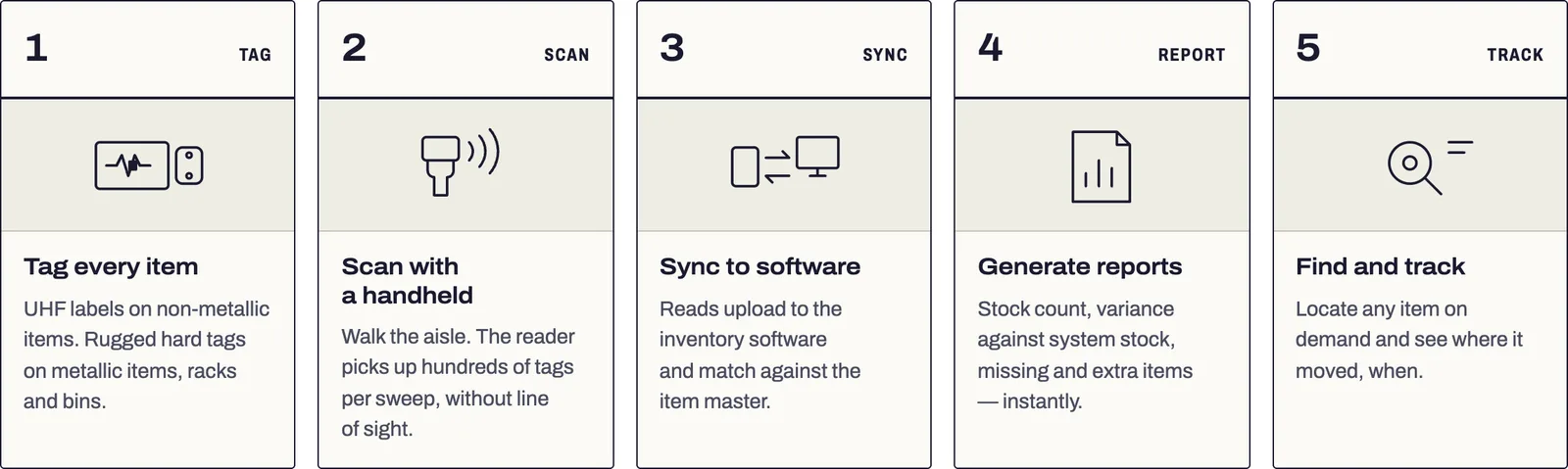
AIR is S-Tech's RFID inventory system, built for factory warehouses and store rooms that still audit stock by barcode. Items are tagged once — UHF labels on non-metallic items, rugged hard tags on metal items, racks and bins — and from then on audits, searches and movements are read by radio instead of by hand. A handheld reader picks up hundreds of tags per sweep without line of sight, the reads sync to the software and are matched against the item master, and the report of count against system stock, missing and extra items is ready at once. Bins, boxes and pallets can carry a master tag linked to the items inside, and where items cannot be tagged, the quantity is kept on the master tag.
Minutes
For a full stock audit, not days
Up to 99%
Audit accuracy
Hundreds
Of tags read per sweep
Why this exists
What it fixes
These are the problems clients describe to us before they buy. If none of them sounds like your week, this may not be the right product — tell us and we will point you at a better one.
What we hear
A barcode audit means days of manual work, scanning every label by hand, rack after rack.
Missed labels, double scans and wrong entries make the stock figures unreliable.
Operations slow down or stop while the audit runs.
Skilled people spend days counting instead of moving material.
What is inside
11 modules
Every deployment turns on the modules you need. Nothing here is a separate purchase unless the plan says so.
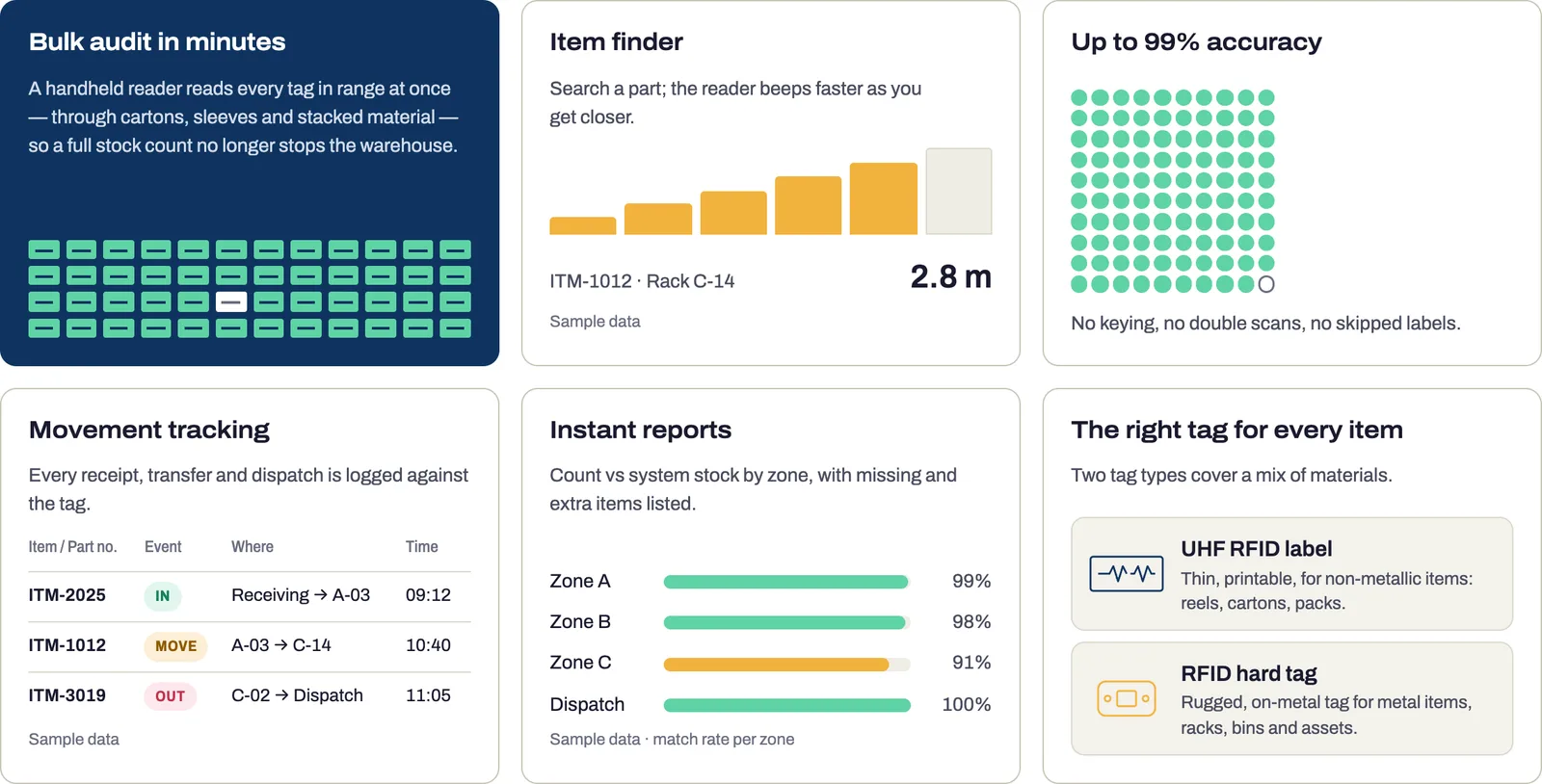
Bulk RFID audit
Walk the aisles with a UHF handheld. Every tag in range is read at once, through cartons and stacked material, so a full count no longer stops the warehouse.
Item finder
Search for a part and the reader guides you to it by signal strength, beeping faster as you get closer.
Movement tracking
Every receipt, transfer and dispatch is logged against the tag, with where it moved from and to and when.
Inventory item master
Add items, part numbers and locations, and link each item to its RFID tag.
Master & child tagging
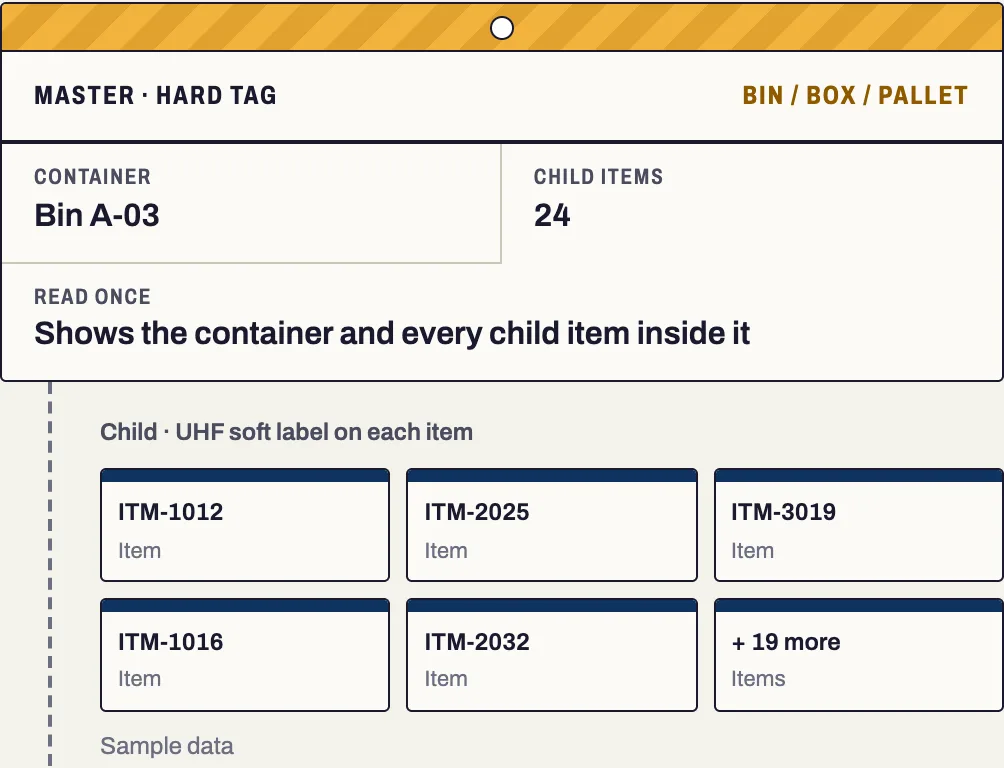
A hard tag on each bin, box, crate or pallet is the master; labels on the items inside are its children. One read shows the container and every child item in it.
Master-tag quantity mode
For metal containers, many metal items together or low-cost bulk parts, only the master tag is read and the quantity stored on it is shown. Quantity changes are updated manually.
Sync & reconciliation
Handheld reads upload to the inventory software and are matched against the item master.
Instant reports
Count against system stock by zone, with missing and extra items listed, audit results, variance and movement history, ready to export.
Real-time warehouse view
Admin sees scans, movements and stock as they happen.
Roles & permissions
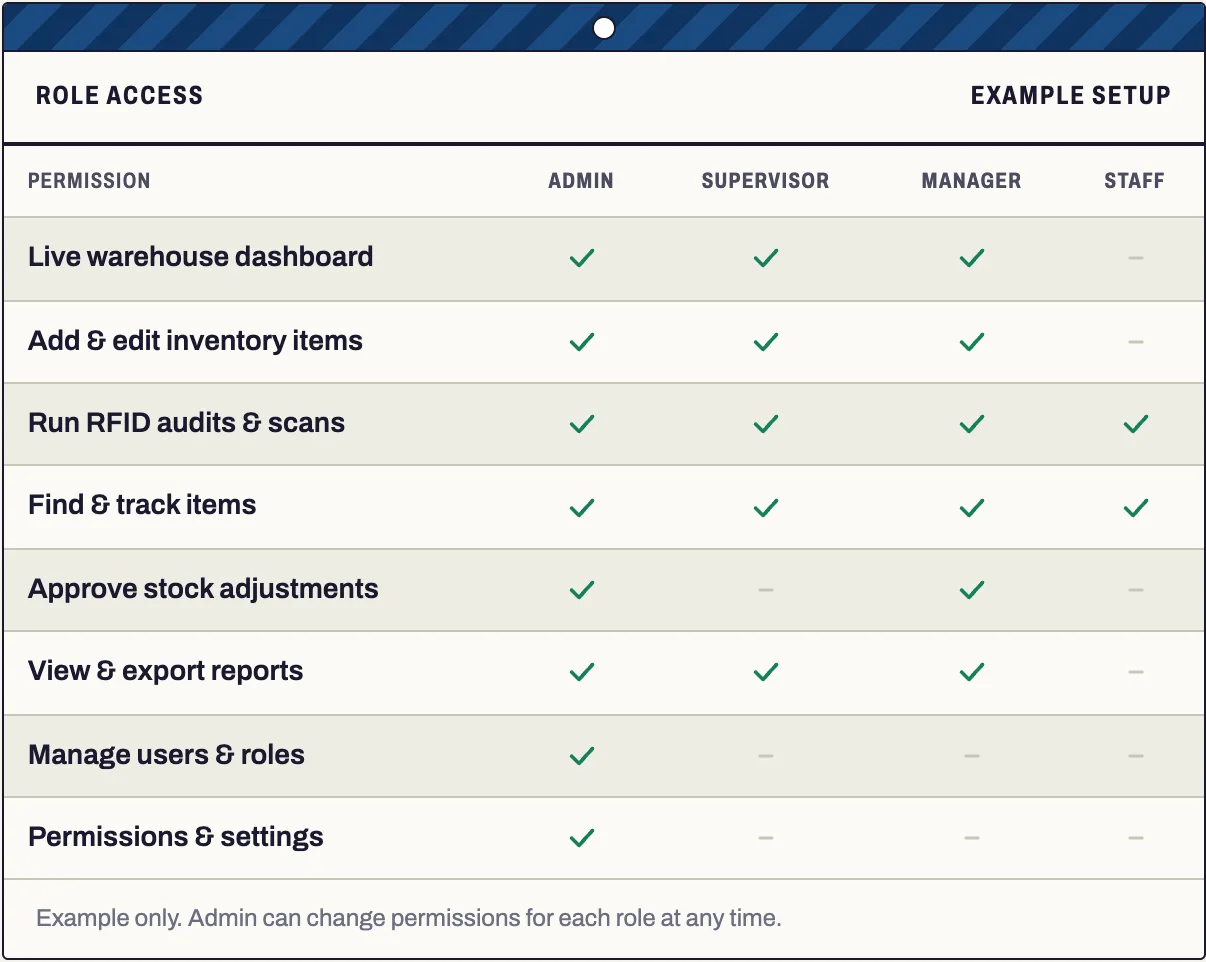
Separate roles for Admin, Supervisor, Manager and Staff, including who can approve stock adjustments. Admin turns features and permissions on or off for each role and user.
Tag encoding
An RFID encoding printer prints and encodes UHF labels in one pass, ready to stick on items.
The RFID difference
What RFID adds over manual and barcode
Barcode and manual entry still work everywhere in this product. This is what changes when you add RFID on top.
- A handheld reads every tag in range at once, so a full audit takes minutes instead of days of scanning one label at a time.
- No line of sight is needed, so tags are read through cartons and stacked material without unpacking anything.
- There is no manual keying, no double scan and no skipped label, which is where barcode audit errors come from.
- A specific part can be found by signal strength, which a barcode cannot do.
Deployment
Cloud, your server, or no internet at all
The same software either way. This is a deployment choice, not a different edition with fewer features.
Cloud
Hosted and managed. Nothing to install, live in days.
Self-hosted
On your own server, inside your building. You own the database.
Runs on
- Inventory software with admin dashboard
- UHF RFID handheld reader
Integrates with
- Existing item master, mapped during setup
- S-Tech Smart Gate & Visitor Management — inward shipments logged at the gate expected at RFID receiving
- Report export
Who it is for
- Manufacturing warehouses that audit stock by barcode
- Factory store rooms with metal parts, racks and assets
- Stores teams that need to find a specific part quickly
- Plants that cannot stop operations for days to count stock
How it is sold
Plan tiers
Actual pricing depends on modules, users, sites and whether you host it yourself, so it is quoted. These tiers tell you where you would sit.
Complete
Everything in Audit plus item finder, movement tracking, master and child tagging, roles and permissions and the real-time warehouse view.
Get a priceSite-wide
Everything in Complete across the warehouse and store rooms, with master-tag quantity mode, in-house tag encoding and integration with S-Tech gate management.
Get a priceEvery S-Tech product
The same nine promises, on all 22 products
These are not per-product features. They apply to everything we build, and they are the reason our software works on sites where other systems do not.
RFID-first
Every product is built around RFID speed and modern technology from the start, not bolted on afterwards.
Any RFID hardware
Ready to configure with any make of RFID hardware. Barcode, QR code and traditional manual methods work by default.
Runs anywhere
Web, Windows, macOS, Linux, Ubuntu, Unix and Android. Your team uses the machine it already has.
Online or offline
Works fully online in the cloud, or fully offline on a local server, and syncs when a connection returns.
Self-hosted option
Host it on your own server and keep the data inside your building. No dependence on our infrastructure.
White-label
Available under your own brand — logo, colours, product name and domain.
Customisable
Every deployment is unique. Modules, fields, forms, reports and workflows are changed to fit your process.
Performance & reliability
Built for speed and uptime under real load, on real hardware, in places with unreliable power and network.
Secure by design
Encrypted data, role-based access, full audit trail and scheduled backups. You own the data.
A note on wording: where we say "fully offline" we mean the system runs on a local server on your own network with no internet connection, and syncs when one returns. Where we say "secure" we mean encrypted data, role-based access, a full audit trail and backups you control. We would rather be specific than round it up to 100%.
Questions
Before you ask us
The things buyers actually check. If your question is not here, ask it — we answer honestly, including when the answer is no.
Can metal items be tagged?
Yes. Rugged on-metal hard tags go on metal items, racks, bins and assets. Thin printable UHF labels go on non-metallic items such as reels, cartons and packs.
What if tags on items inside a container cannot be read?
Metal bins, boxes or pallets, many metal items together, and low-cost bulk parts such as washers, nuts and bolts can stop child tags reading reliably or make them uneconomic. In those cases only the master tag on the container is read, and the quantity entered when the tag was assigned is shown each time. Quantity changes are updated manually.
How long does an audit actually take?
It depends on the size of the warehouse and the number of tags, but a handheld reads hundreds of tags per sweep, so a count that took days by barcode takes minutes.
How is AIR different from the Warehouse Management System?
WMS runs the whole warehouse with bins, picking and dispatch. AIR is focused on replacing barcode audits in factory warehouses and store rooms, with item search, movement tracking and master and child tagging for containers and metal items.
Is it hosted or on our own server?
Either. We host it for you in the cloud, or install it on a server inside your premises.
Can we print our own tags?
Yes. With an RFID encoding printer, labels are printed and encoded in one pass and are ready to stick on items.
Related products and solutions
Software
Warehouse Management System
Inbound to dispatch, counted by RFID instead of by hand
Read moreSoftware
Smart Gate & Visitor Management
Visitors, staff, vehicles and shipments on one gate register
Read moreSoftware
Returnable Pallet & Asset Tracker
Every returnable box counted out and back at the dock
Read moreSoftware
Universal Enterprise Asset & Business Operations Platform
The flagship — asset tracking joined to daily operations, in any industry
Read moreSolution
Warehouse Management
Receive, store, pick and dispatch faster, with stock accuracy that holds between counts instead of decaying.
Read moreSolution
Asset Management
Know what you own, where it is and what condition it is in — verified by a walk-through, not a spreadsheet.
Read moreSolution
Factory Automation
Track work in progress through the line automatically, with traceability from raw material to finished goods.
Read moreSee AIR on your own data
A demo runs on your process, not a canned dataset. Bring a real scenario and we will show you how it handles it — including the parts it does not.
Or call +91 97305 32888 — Monday to Saturday, 9:30 am to 6:30 pm.