
Retail & Hospitality · Software
Jewellery ERP
Tag each piece, count the showroom in minutes instead of days, and bill at today's rate with making charges, wastage, stones and old gold handled properly.
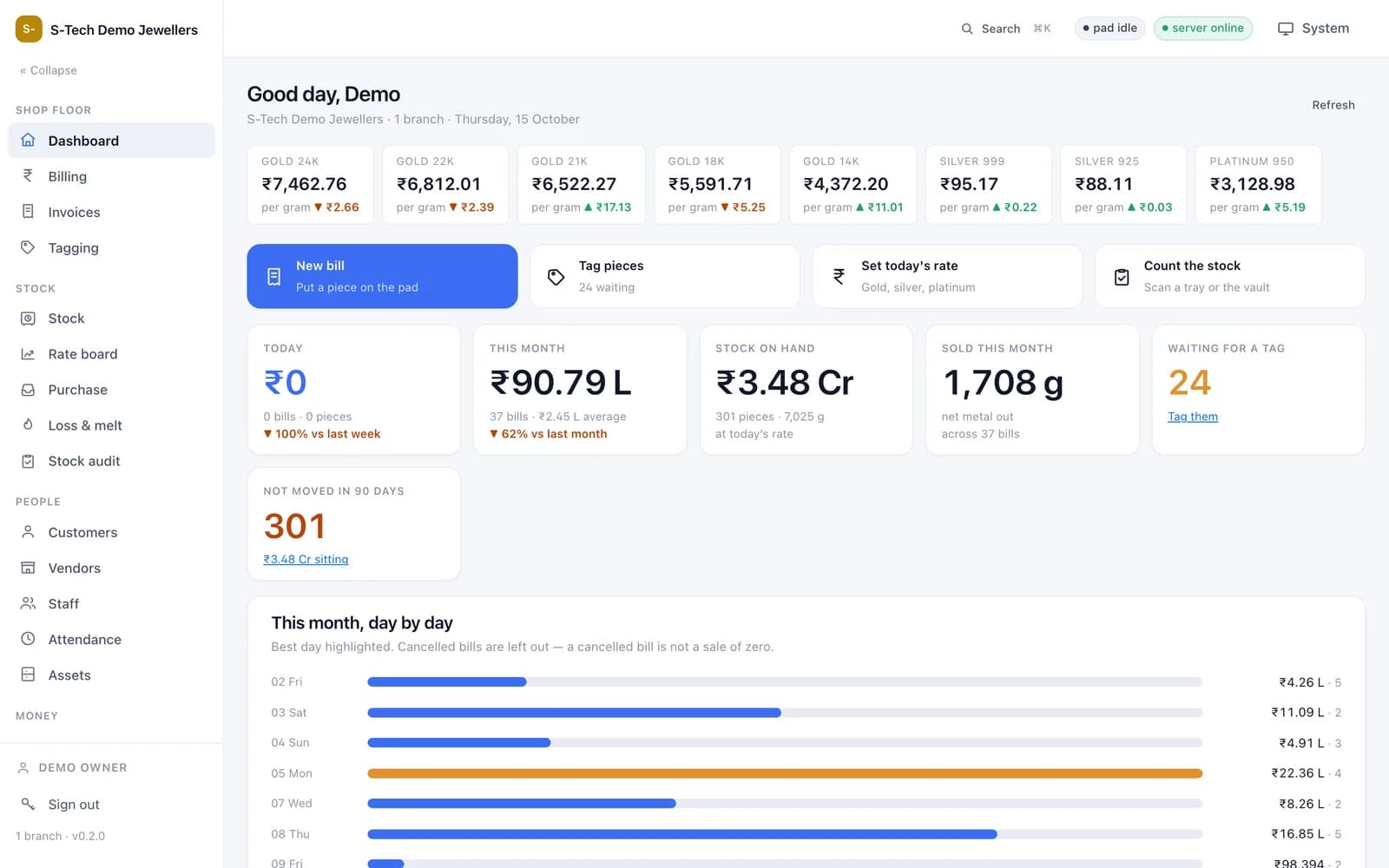
Inside the product
Real screens
Shown on demo data. Click any screen to see it full size.
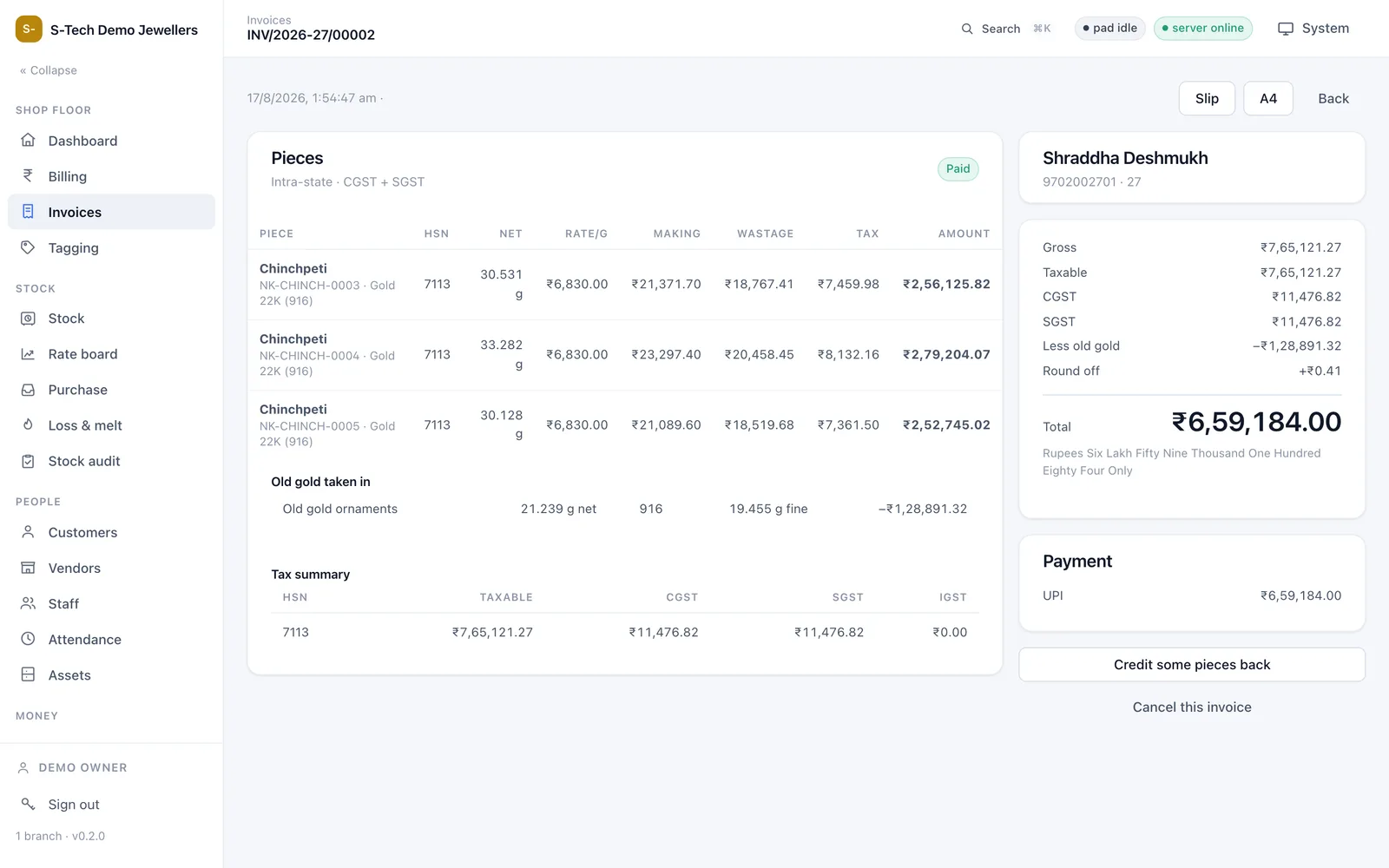
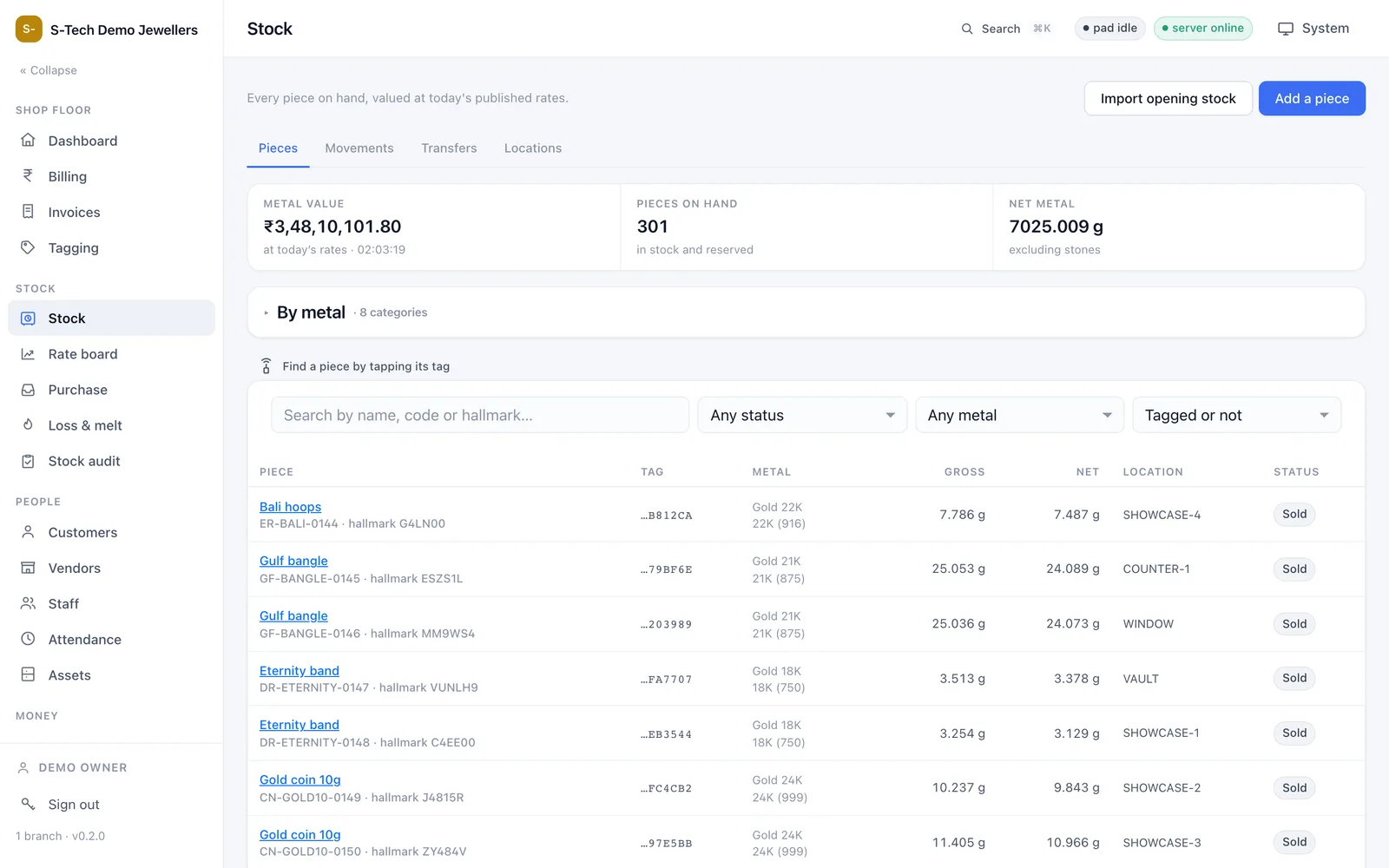
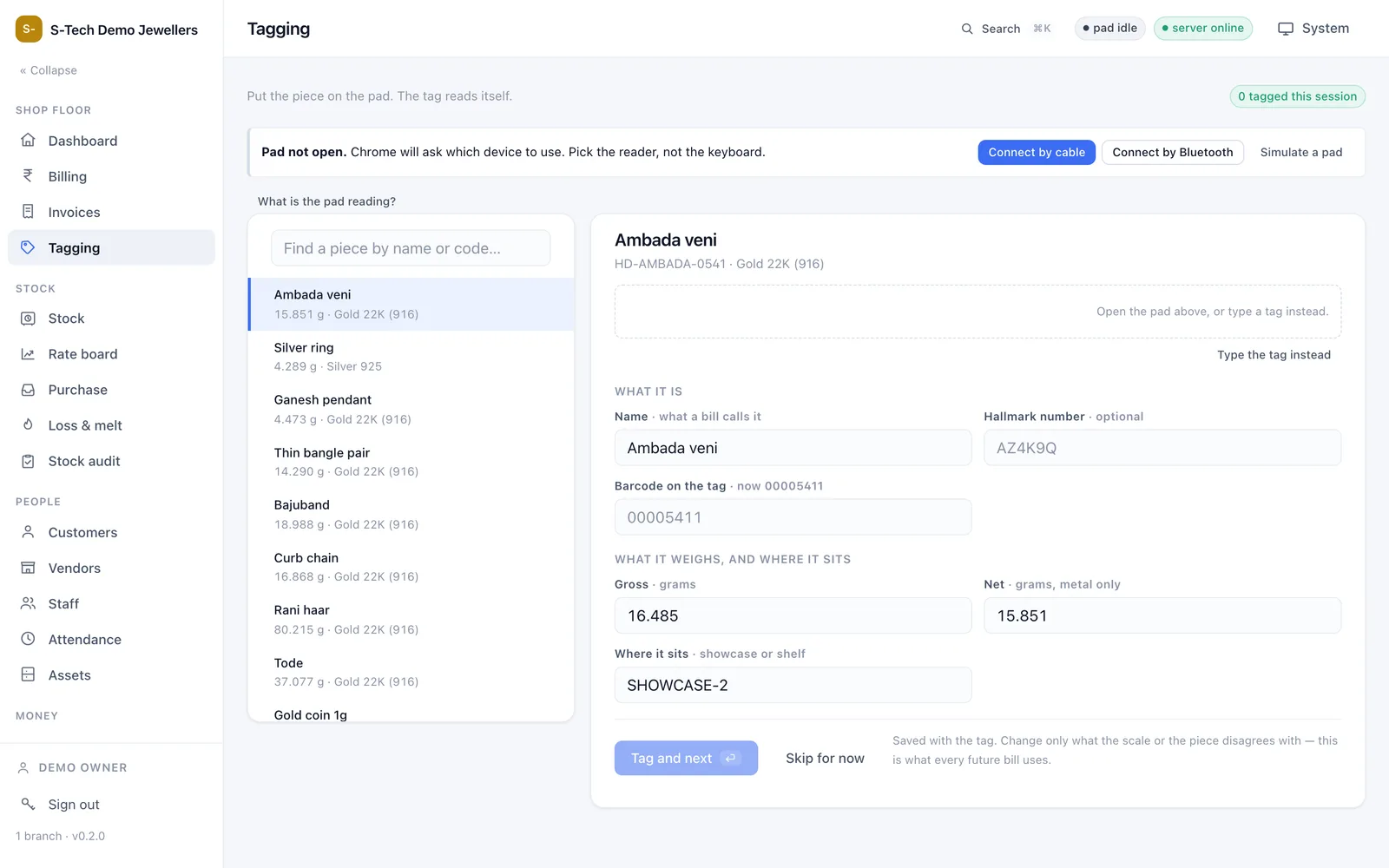
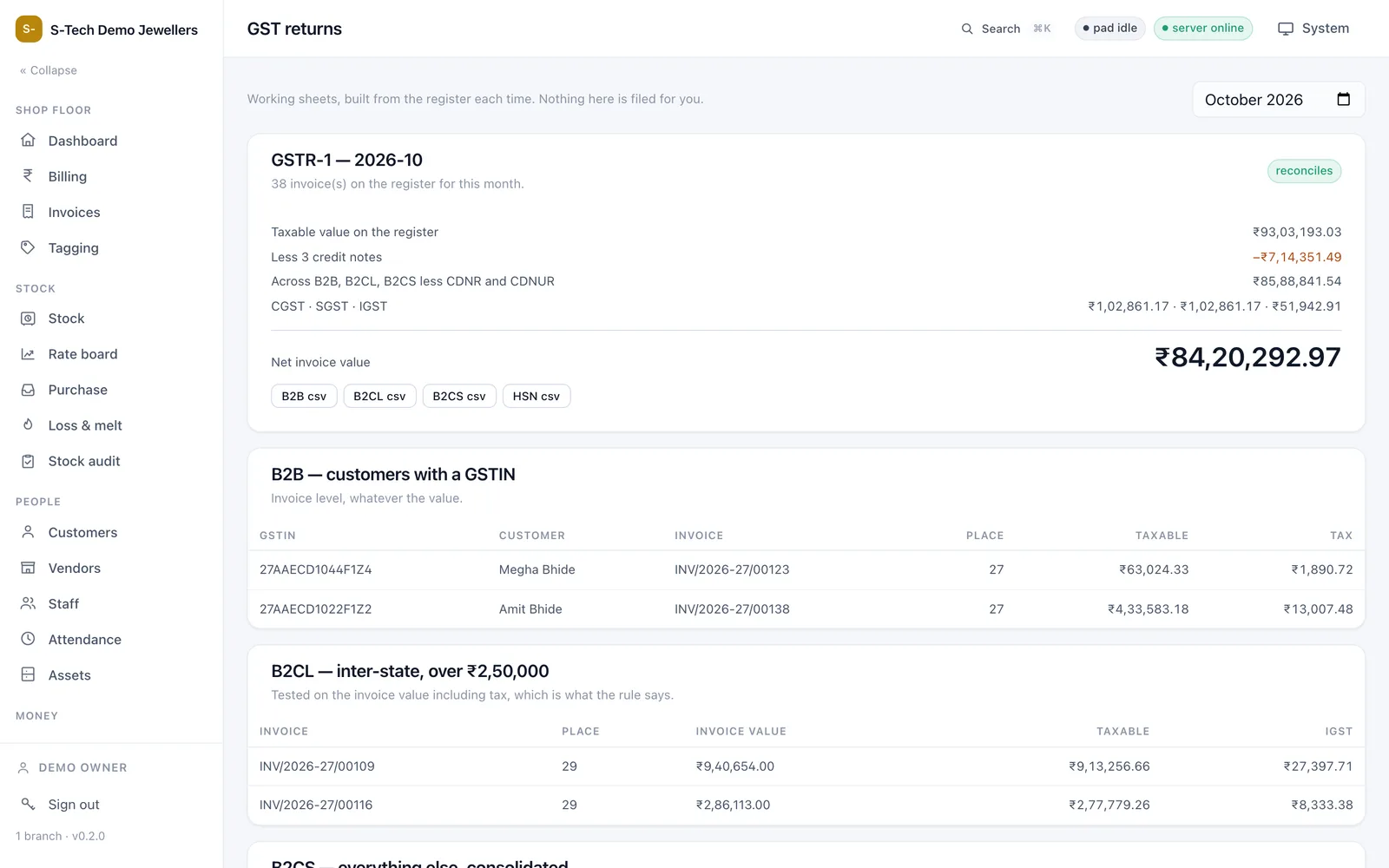
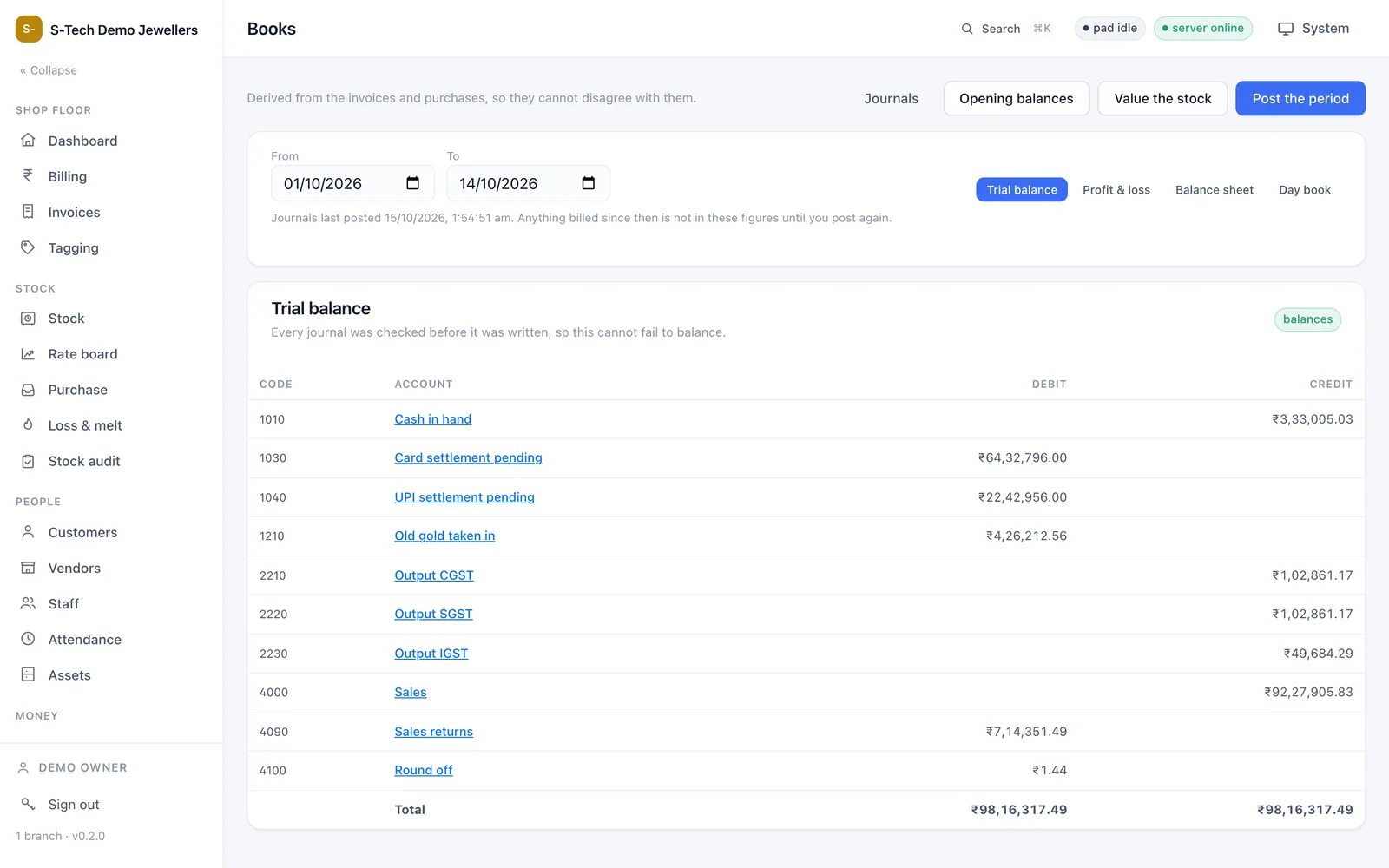
S-Tech Jewellery ERP is built around one fact: in a jewellery business every single piece is unique, and counting them by hand is the most expensive routine job in the shop. Each piece gets its own record, a barcode and an RFID tag, so a handheld can count a showcase or the vault in minutes and a piece placed on the counter pad comes straight onto the bill. Around that sits the rest of the shop — the daily rate board, billing with old gold exchange, purchase, losses and melting, customers, staff attendance, and books, GST returns and a metal position that are all built from the same bills. It runs in the browser as a hosted service, and each shop's data sits in its own separate database.
Minutes
Showroom count, not days
Per piece
Tag, weight, hallmark and cost tracked individually
Daily
Showcase counts become routine
Why this exists
What it fixes
These are the problems clients describe to us before they buy. If none of them sounds like your week, this may not be the right product — tell us and we will point you at a better one.
What we hear
Physical stock-take shuts the showroom for a day or two, so it happens rarely and shrinkage is found late.
Making charges, wastage, stone value and old gold exchange are worked out by hand on every bill, which is slow at the counter and inconsistent between staff.
Rates change every day and get overwritten, so an old bill cannot be explained when a customer or the accountant asks.
The accounts, GST returns and the gold actually held in the safe are rebuilt from bill books at month end, and nobody can say which pieces have not moved in months.
What is inside
12 modules
Every deployment turns on the modules you need. Nothing here is a separate purchase unless the plan says so.
Piece-level stock
Every piece has its own record — design, metal and purity, gross and net weight, stone value, hallmark (HUID), cost, barcode and RFID tag. Showcases, vault and counters are locations; every change is written to a movement ledger. Opening stock imports from Excel, and pieces move between branches with dispatch and receipt.
RFID tagging
Put the piece on the counter pad, the tag reads itself, check the weights and save — then the next piece. Re-tagging needs a reason, a tag cannot be bound to two pieces, and Code 128 barcode tags print for the same pieces.
Billing counter
Tap a piece on the pad or scan its barcode and it lands on the bill with weight, purity, making, wastage, stones and GST. Old gold is taken in by weight and purity, payment can be split across cash, card, UPI and bank, and bills can be held and resumed. Thermal slip or A4, credit notes, cancellation with a reason, and a day close.
Rate board & pricing
Per-gram rates for every metal and purity — gold 24K to 14K, silver and platinum, or any grade you add. A rate is never overwritten, so every past bill can be explained. Optional live rate feed with a premium per metal, and making rules per gram, as a percentage, fixed or by weight slab.
RFID stock audit
Start a count for the whole branch, one showcase or the vault and the books freeze. Handheld reads come in live, and the reconciliation lists what was found, missing, in the wrong place, sold or unknown, with the missing weight valued at today's rate.
Purchase & vendors
Vendors split into karigars, wholesalers and refiners. Purchase invoices with gross and net weight, purity, rate and making; goods inward goes straight to the tagging queue. Purchase returns and vendor balances.
Returns, loss & melting
Sales returns through credit notes linked to the original bill, with the piece back in stock. Loss, theft and damage write-offs with reasons, and melting entries that turn pieces back into metal weight.
Customers
Customer master with phone, address, GSTIN and KYC. PAN is stored encrypted and is asked for on bills above the legal threshold. Purchase history and outstanding balance on every customer.
Books & metal position
Journals posted from sales and purchases, manual journals, opening balances, trial balance, profit and loss, balance sheet and day book. A metal position shows the fine grams in and out by purity — what should be in the safe.
GST returns
GSTR-1 working sheets — B2B, B2CL, B2CS, credit notes and HSN summary — and a GSTR-3B summary, built from the invoice register each time and exported as CSV for your accountant.
Dashboard & reports
Today's rates, sales for the day and month, stock value at today's rate, pieces waiting for a tag and dead stock aged from the day it came in. Sales, margin and dead-stock reports with CSV export, and one search box across pieces, tags, hallmarks, bills and customers.
Staff, attendance & assets
Staff master with UHF cards, door punches, shifts, leave and a monthly muster roll. Shop assets — safes, scales, showcases, computers — with custodian, location and depreciation.
The RFID difference
What RFID adds over manual and barcode
Barcode and manual entry still work everywhere in this product. This is what changes when you add RFID on top.
- A handheld reads a whole tray of tagged pieces in one sweep. A barcode count of the same tray means picking up and turning every piece.
- Nothing has to come out of the showcase, so the count can run while the shop is open — pieces sold during the count are reported separately, never as a loss.
- At the counter the piece is simply placed on the pad; there is no code to type and no wrong piece billed by mistake.
- Because a count takes minutes, a daily showcase check becomes routine instead of an annual event, and missing weight is valued the same day.
Deployment
Cloud, your server, or no internet at all
The same software either way. This is a deployment choice, not a different edition with fewer features.
Cloud
Hosted and managed. Nothing to install, live in days.
Runs on
- Web (Chrome or Edge)
- Windows, macOS and Linux counter PCs (in the browser)
- Android tablets (Chrome, Bluetooth pad)
- Android RFID handheld app
Integrates with
- Live gold, silver and platinum rate feeds
- GSTR-1 and GSTR-3B working sheets (CSV)
- Excel opening-stock import
- BIS hallmark (HUID) per piece
- USB and Bluetooth RFID counter pads, opened from the browser
- Code 128 barcode tags and camera scanning
Who it is for
- Single-showroom jewellers
- Jewellers with more than one branch
- Gold, silver, diamond and platinum retailers
- Jewellers moving from barcode or manual counts to RFID
Every S-Tech product
The same nine promises, on all 22 products
These are not per-product features. They apply to everything we build, and they are the reason our software works on sites where other systems do not.
RFID-first
Every product is built around RFID speed and modern technology from the start, not bolted on afterwards.
Any RFID hardware
Ready to configure with any make of RFID hardware. Barcode, QR code and traditional manual methods work by default.
Runs anywhere
Web, Windows, macOS, Linux, Ubuntu, Unix and Android. Your team uses the machine it already has.
Online or offline
Works fully online in the cloud, or fully offline on a local server, and syncs when a connection returns.
Self-hosted option
Host it on your own server and keep the data inside your building. No dependence on our infrastructure.
White-label
Available under your own brand — logo, colours, product name and domain.
Customisable
Every deployment is unique. Modules, fields, forms, reports and workflows are changed to fit your process.
Performance & reliability
Built for speed and uptime under real load, on real hardware, in places with unreliable power and network.
Secure by design
Encrypted data, role-based access, full audit trail and scheduled backups. You own the data.
A note on wording: where we say "fully offline" we mean the system runs on a local server on your own network with no internet connection, and syncs when one returns. Where we say "secure" we mean encrypted data, role-based access, a full audit trail and backups you control. We would rather be specific than round it up to 100%.
Questions
Before you ask us
The things buyers actually check. If your question is not here, ask it — we answer honestly, including when the answer is no.
What kind of tag is used on jewellery?
Small UHF jewellery tags, usually a hang tag or a self-locking loop tag sized so it does not spoil the display. We supply diamond and jewellery tags as part of our hardware catalogue and test them against your trays before rollout.
Do metal and stones interfere with the tag?
They can, which is why tag choice and antenna placement matter. We do a read-rate test on your actual stock and trays before we commit to a design — that is the difference between a system that reads 99% and one that frustrates the staff.
Can it handle old gold exchange and part payment on the same bill?
Yes. Old gold is valued by weight and purity and deducted from the bill, and the balance can be split across cash, card, UPI and bank transfer.
Does it work with live gold rates?
Yes. You publish the day's rate per metal and purity on the rate board, by hand or from a rate feed suggestion with your own premium added. Every bill uses the rate that was published when it was made, and old rates are kept, never overwritten.
Does anything need to be installed on the counter PC?
No. The counter pad opens directly in Chrome or Edge, over USB or Bluetooth. Stock audits use an Android RFID handheld running our app.
Does it work without internet?
No. It is a hosted service and the shop needs an internet connection to bill. Each shop's data is kept in its own separate database.
How is it priced?
By module. Each shop is licensed for the modules it uses — billing, tagging, audit, purchase, accounting, GST, attendance and so on — so you do not pay for parts of the system you do not run.
Related products and solutions
Software
Universal Enterprise Asset & Business Operations Platform
The flagship — asset tracking joined to daily operations, in any industry
Read moreSoftware
Accounting & Tax Filing Software
Books, invoicing and GST that stay ready to file
Read moreSolution
Jewellery Retail
Count the whole showroom in minutes, every day, without taking a single piece out of the tray.
Read moreSolution
Retail Management
Stock that is actually accurate on the shop floor, faster checkout, and fewer items walking out unbilled.
Read moreSee Jewellery ERP on your own data
A demo runs on your process, not a canned dataset. Bring a real scenario and we will show you how it handles it — including the parts it does not.
Or call +91 97305 32888 — Monday to Saturday, 9:30 am to 6:30 pm.